N030-M2 Tier 3 · Intermediate · medium analytics · Streamhub

Return the ID and session count of every user who has recorded more than `5` sessions

Part of Common Table Expressions (CTEs) in SQL

The problem

Streamhub's growth team is identifying highly engaged users.

Write a query to return the ID and session count of every user who has recorded more than 5 sessions.

Assumptions:

  • The sessions table has one row per session with a user_id.
  • A user's session count is the number of sessions records linked to that user_id.
  • Only users whose session count exceeds 5 should appear.

Output:

  • One row per qualifying user, with columns user_id and session_count.
Schema · analytics 5 tables
users
id integer
name text
email text
country text
plan text
signed_up_at timestamptz
is_active boolean
conversions
id integer
user_id integer
converted_at timestamptz
plan text
amount numeric
sessions
id integer
user_id integer
started_at timestamptz
ended_at? timestamptz
event_count integer
events
id integer
user_id integer
session_id? integer
event_type text
occurred_at timestamptz
properties? jsonb
periods
id integer
name text
start_month integer
end_month integer

Run previews · Check grades

Write a query, then run it to see results here.

Worked solution Try it yourself first
Solution query
WITH
  user_sessions AS (
    SELECT
      user_id,
      COUNT(*) AS session_count
    FROM
      sessions
    GROUP BY
      user_id
  )
SELECT
  user_id,
  session_count
FROM
  user_sessions
WHERE
  session_count > 5

The shape

The WITH layer computes a per-user session count. The main query then filters that named result with WHERE session_count > 5, comparing against the aggregate as a column.

Clause by clause

  • The WITH clause defines user_sessions:
WITH user_sessions AS (
  SELECT user_id, COUNT(*) AS session_count
  FROM sessions
  GROUP BY user_id
)

GROUP BY user_id partitions sessions per user; COUNT(*) counts each partition. The named layer ends up with one row per user, every user included regardless of count.

  • SELECT user_id, session_count FROM user_sessions WHERE session_count > 5 is the main query. It reads the named layer and keeps only the rows where the count exceeds 5. Users 1 and 3 survive with 9 sessions each; every other user falls below the threshold and drops out.

Why this and not a derived table in FROM

A derived table would compute the same aggregation in the main query's FROM clause and apply the threshold in the same WHERE. Both forms return the same two rows. The WITH version moves the aggregation above the main query and gives it a name. The main query then reads as two clear steps: compute the per-user count, keep the ones above 5. The derived-table version compresses both into one nested statement.

The trap

The threshold runs on the aggregate, which only exists once the grouping is finished. The named column session_count is the output of COUNT(*) per user, not a column on sessions. The filter belongs in the main query, against the layer's output, because that is the only place the aggregate exists as a column to compare against.

You practiced computing a per-user count in a WITH layer and applying a threshold check in the main query.

How you actually get good at SQL

Reading explains SQL. Writing it, over and over with instant feedback, is what makes you fluent.

That's the whole SQLMaxx loop: 600+ real problems, instant AI feedback, mastery you can actually see, and spaced review that won't let you forget.

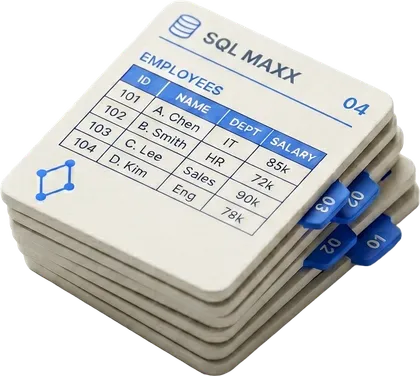
A stack of SQL practice problem cards, the top card showing an employees table.
615 problems · 66 concepts

Real problems. Not toy examples.

615 hand-built problems spanning all 66 concepts, from basic SELECTs to window functions, built on real schemas and real business questions, the kind you'll actually get asked on the job. Enough reps to make SQL automatic.

A retro computer showing a SQL query marked correct with a green checkmark.
Instant AI feedback

Write a query. Know if it's right in one second.

No copying an answer and hoping it clicked. The AI grader checks your real query against real data, catches exactly what's wrong, and explains the fix in plain English, like a senior analyst reading over your shoulder on every problem.

A circular mastery progress dial filling from blue to green, the SQLMaxx diamond at its center.
Mastery tracking

Stop guessing whether you actually know it.

SQLMaxx tracks every concept and shows you what you've mastered and what's still shaky. Your skills fill in one concept at a time, so 'I think I get joins' becomes something you can prove.

A SQL query editor circled by a blue return arrow with a clock, scheduled to come back for review.
Spaced review

Learn it once. Keep it for good.

Most of what you learn this week fades by next week. So when a concept comes due for review, SQLMaxx hands you a fresh problem to solve from a blank editor, not a flashcard to re-read. A research-backed spaced-repetition algorithm (FSRS) times each return for right before you'd forget, so your SQL is still there months later, when the interview or the job actually needs it.

Practice, feedback, mastery, review. That's the loop that turns reading into real skill.

Start free

No account, no credit card. Start solving in under a minute.