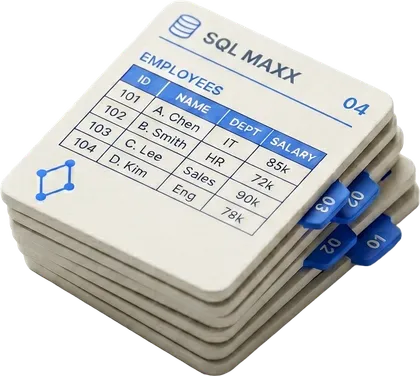
Helix Systems' HR director wants a complete employee roster showing each employee's name alongside the name of their department.
Write a query to return one row per employee with the employee's name and their department's name.
Assumptions:
- Both tables have a column called
name, so every column reference must be qualified by its table alias.
Output:
- One row per employee, with columns
employee_nameanddepartment_name.
Schema · hr 4 tables
Run previews · Check grades
Write a query, then run it to see results here.
Worked solution Try it yourself first
SELECT
  e.name AS employee_name,
  d.name AS department_name
FROM
  employees e
  JOIN departments d ON e.department_id = d.id
The shape
Both employees and departments have a name column, so the aliases e and d are doing real work: they're the only way PostgreSQL knows which name belongs to whom. The join itself pairs each employee with their department row on e.department_id = d.id, and SELECT then pulls the right name from each side.
Clause by clause
FROM employees ereads from the employees table and aliases it ase. The alias is mandatory in a query like this; without it, everynamereference would have to be written asemployees.nameordepartments.namein full, which gets noisy fast.JOIN departments d ON e.department_id = d.idpairs each employee with their department. For every row inemployees, PostgreSQL finds the row indepartmentswhoseidequals that employee'sdepartment_id. The result is a combined row holding both the employee's columns and the department's columns.SELECT e.name AS employee_name, d.name AS department_namepicks the rightnamefrom each side. The aliasese.nameandd.nameare unambiguous —e.nameis the employee,d.nameis the department. The output aliases (employee_name,department_name) then label the columns by role so the roster reads cleanly. Drop either qualifier and PostgreSQL would reject the query with an "ambiguous column reference" error before it ran a single row.
You practiced disambiguating same-named columns across joined tables. The recurring rule: when two tables share a column name, every reference to either column must carry its table alias — otherwise PostgreSQL rejects the query as ambiguous.