N007-E1 Tier 1 · Foundations · easy ecommerce · Brightlane

Return each product's name and price, sorted from the least expensive to the most expensive

Part of ORDER BY and Result Sorting in SQL

The problem

Brightlane's product team is preparing a catalogue sorted by price for a buyer presentation.

Write a query to return each product's name and price, sorted from the least expensive to the most expensive.

Assumptions:

  • The products table contains every product in Brightlane's catalogue.
  • When two products share the same price, the product with the lower id should appear first.

Output:

  • One row per product, with columns name and price, sorted by price ascending, then by id ascending.
Schema · ecommerce 5 tables
categories
id integer
name text
parent_id? integer
products
id integer
name text
category_id integer
price numeric
stock_qty integer
attributes? jsonb
order_items
id integer
order_id integer
product_id integer
quantity integer
unit_price numeric
customers
id integer
name text
email text
city? text
country text
created_at timestamptz
is_active boolean
orders
id integer
customer_id integer
ordered_at timestamptz
status text
total_amount numeric

Run previews · Check grades

Write a query, then run it to see results here.

Worked solution Try it yourself first
Solution query
SELECT
  name,
  price
FROM
  products
ORDER BY
  price,
  id

The shape

A two-key ORDER BYprice first, then id as a tiebreaker — turns the catalogue into a deterministic least-to-most-expensive list, even when two products share a price.

Clause by clause

  • SELECT name, price pulls the two columns the buyer presentation needs. Nothing else from products appears in the output, but every product is still considered for sorting.
  • FROM products reads the catalogue. Without any WHERE, every row in the table is in play.
  • ORDER BY price, id sorts by price ascending — ascending is the default, so no ASC is needed — and uses id to break ties. Two products at 12.99 (HDMI Cable 2m and Picture Frame 8x10) come back in the order their id values prescribe, so the result is reproducible run after run.

Why this and not ORDER BY price on its own

Without the id tiebreaker, PostgreSQL is free to return the two 12.99 rows in either order, and that order can change between runs as the planner picks different strategies. The query is still correct in the sense that the prices are sorted, but the row sequence inside any group of equal prices is up to the engine. The second sort key locks the order down so the presentation looks the same every time it's exported.

You practiced sorting on a primary key with a secondary tie-breaker. Adding a stable second sort key is the recurring fix for any list whose primary sort can produce ties — it makes the output order deterministic instead of arbitrary.

How you actually get good at SQL

Reading explains SQL. Writing it, over and over with instant feedback, is what makes you fluent.

That's the whole SQLMaxx loop: 600+ real problems, instant AI feedback, mastery you can actually see, and spaced review that won't let you forget.

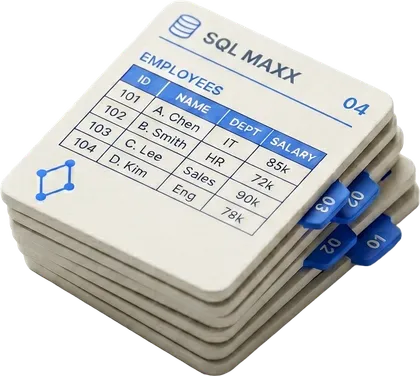
A stack of SQL practice problem cards, the top card showing an employees table.
615 problems · 66 concepts

Real problems. Not toy examples.

615 hand-built problems spanning all 66 concepts, from basic SELECTs to window functions, built on real schemas and real business questions, the kind you'll actually get asked on the job. Enough reps to make SQL automatic.

A retro computer showing a SQL query marked correct with a green checkmark.
Instant AI feedback

Write a query. Know if it's right in one second.

No copying an answer and hoping it clicked. The AI grader checks your real query against real data, catches exactly what's wrong, and explains the fix in plain English, like a senior analyst reading over your shoulder on every problem.

A circular mastery progress dial filling from blue to green, the SQLMaxx diamond at its center.
Mastery tracking

Stop guessing whether you actually know it.

SQLMaxx tracks every concept and shows you what you've mastered and what's still shaky. Your skills fill in one concept at a time, so 'I think I get joins' becomes something you can prove.

A SQL query editor circled by a blue return arrow with a clock, scheduled to come back for review.
Spaced review

Learn it once. Keep it for good.

Most of what you learn this week fades by next week. So when a concept comes due for review, SQLMaxx hands you a fresh problem to solve from a blank editor, not a flashcard to re-read. A research-backed spaced-repetition algorithm (FSRS) times each return for right before you'd forget, so your SQL is still there months later, when the interview or the job actually needs it.

Practice, feedback, mastery, review. That's the loop that turns reading into real skill.

Start free

No account, no credit card. Start solving in under a minute.